Last Updated: October 26, 2026
Quick Summary
Camera-shy couples get natural wedding photos when their photographer gives them actions instead of poses, such as walking, whispering, or holding hands. Lightly directed prompts move your attention off the lens and onto your partner, so real expressions replace forced smiles. Tell your photographer you are camera-shy when you first inquire.
- The Silhouette Studio has photographed more than 500 couples since 2010.
- Full couple portrait sessions usually take 30 to 60 minutes, with a 5-minute warm-up.
- Give idle hands a job, like resting a palm over your partner’s heart.
- Walking is the reset button when a prompt falls flat.
- Ask for a full gallery, not just highlights, before you book.
Table of Contents
- Why Camera-Shy Couples End Up With Stiff Wedding Photos
- Natural Wedding Poses for Couples Who Hate Posing
- What to Do With Your Hands in Wedding Photos
- Wedding Photography Prompts for Couples Who Feel Awkward
- How Long Do Wedding Portraits Take, and How to Plan for It
- How to Tell Your Photographer You’re Camera-Shy Before Booking
- Book a Portrait Session That Puts You at Ease
- Frequently Asked Questions
Why Camera-Shy Couples End Up With Stiff Wedding Photos
Most stiff wedding photos are not the couple’s fault. They happen when a photographer asks two nervous people to hold a smile and freeze.
A forced pose asks you to perform an emotion on command, and the camera knows the difference. Genuine expressions come from real moments, not instructions.
This guide covers what to do with your hands, how to move instead of stand, and how to tell a photographer you are camera-shy before you book.
The Difference Between Candid Photos and Lightly Directed Portraits
Candid photography captures unposed moments with no direction from the photographer.
Both belong in a wedding gallery: candid work gives you the laughter, tears, and dance floor chaos; lightly directed portraits give you the images you hang on a wall.
The key difference is control. In a forced pose, the photographer controls everything.
That distinction matters for camera-shy couples: you don’t need to be spontaneous for two hours straight, just small, gentle prompts and room to be yourselves.
Natural Wedding Poses for Couples Who Hate Posing
The best natural wedding poses for couples aren’t poses at all, they’re actions: walking, whispering, holding hands, leaning in. Give a couple something to do and the awkwardness disappears.
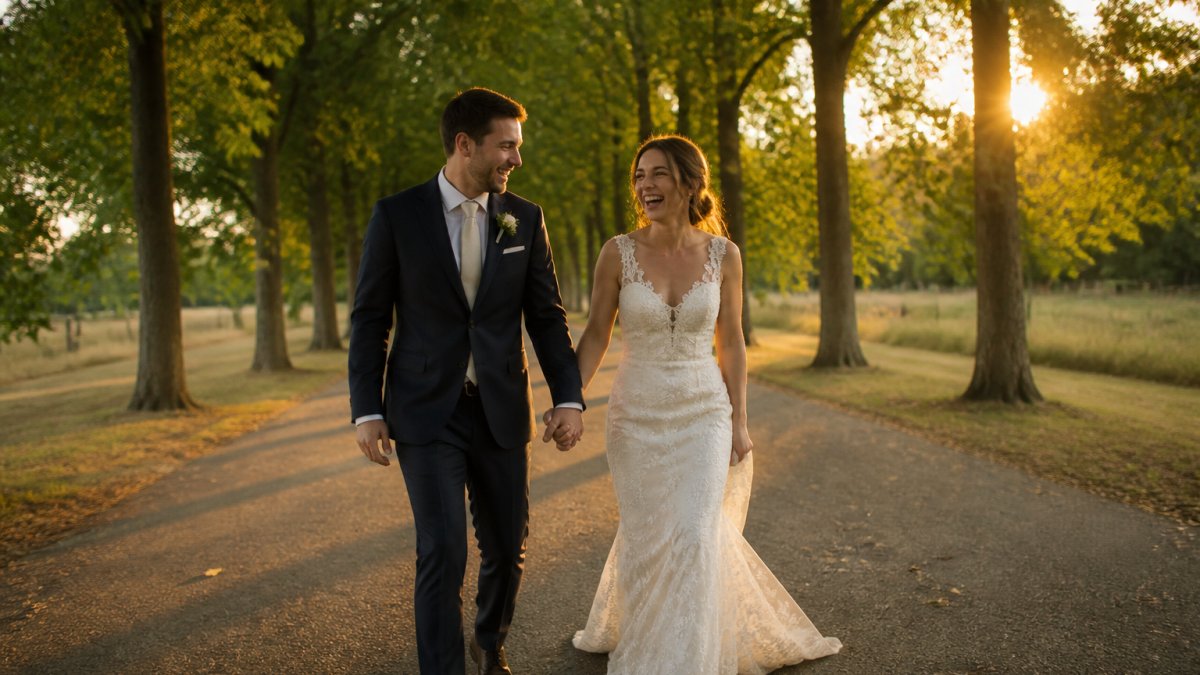
Here are the natural wedding poses for couples we return to most often:
- The walk. Hold hands and walk toward the camera, then away from it.
- The whisper. One of you leans in and tells the other something. It can be silly.
- The forehead touch. Foreheads together, eyes closed, hands resting on each other’s arms.
Notice that none of these require you to look at the lens. That single change removes most of the pressure.
Walk, Don’t Stand: Movement That Produces Real Expressions
Movement is the fastest route to authentic photos. When you walk, your body does something natural, and your face follows.
Ask your photographer to have you walk a short stretch, then add a small instruction: swing your joined hands, look at each other, or count your steps out loud.
A common mistake is walking too slowly and too carefully. Walk at your normal pace. If you feel a little ridiculous, good.
What to Do With Your Hands in Wedding Photos
The most common question we hear is what to do with your hands in wedding photos. The answer: give them a job.
Idle hands make people feel awkward. Hold hands, rest a palm on a lapel, adjust a cuff, or tuck a strand of hair behind an ear.
Try these hand fixes when you feel stuck:
- Rest one hand on your partner’s chest, over the heart.
- Hold the bouquet with both hands at waist height.
- Let one hand hang loose and the other find your partner’s.
Avoid the stiff lineup of fingers hanging straight down. If your hands feel heavy, move them, movement reads as life.
Wedding Photography Prompts for Couples Who Feel Awkward
Wedding photography prompts for couples work because they replace “look happy” with something concrete to do. The difference is specificity: “act natural” is a performance demand, while “tell her the worst outfit you have ever seen her wear” is a task you can actually complete.
Told to feel an emotion, your face guesses what it should look like and the result reads as a mask. Given a task, your attention moves off the camera and onto your partner, and your expression follows.
Walking prompts
- “Hold hands and walk toward me at your normal pace. Do not slow down for the camera.”
- “Walk away from me, then turn back when I count to three, but only one of you turns.”
- “Walk together and swing your joined hands like you did on your first date.”
The counting prompt is our most reliable laugh-generator: couples almost always mess up the count, and the forced smile disappears.
Talking prompts
- “Lean in and whisper the worst outfit you have ever seen the other person wear.”
- “Tell each other your favorite thing about the other, but start with ‘the thing I hate most is…’ and then pivot.”
- “Describe your partner to me in three words, and make the third one a lie.”
The last one matters for camera-shy couples: permission to say something mundane removes the pressure to be romantic on command, and the relief shows as a real expression.
Touch prompts
- “Hold each other and take three slow breaths together. I will shoot on the exhale.”
- “Put one hand on your partner’s chest, over the heart, and leave it there.”
- “Give each other a hug and do not let go until I say so, I will take longer than you expect.”
Memory prompts
- “Look at each other and silently remember the first time you met.”
- “Tell each other the moment you knew. Do not say it out loud, just mouth it.”
- “Think about the last time you laughed so hard you could not breathe. Now try not to laugh.”
The ‘try not to laugh’ prompt works because suppression almost always fails, and the failure is the photo.
If a prompt falls flat, say so out loud. A good photographer will switch to another one without a second thought. The worst outcome is a couple silently enduring a prompt they hate while the shutter keeps firing.
What to do when a prompt fails
A prompt fails when it asks for an emotion rather than an action, is too abstract (“be playful”), or puts one partner on the spot.
Experienced wedding photographers keep three prompts ready for each of the four categories above, so there’s always a fallback that fits the moment rather than the shot list.
How Long Do Wedding Portraits Take, and How to Plan for It
Wedding portraits usually take 30 to 60 minutes for a full couple session, and 10 to 15 minutes for a short set right after the ceremony, depending on your timeline, venue, and how many family groupings you want.
Anyone who promises a full portrait session in five minutes is rushing you, and rushed couples look rushed in photos. For camera-shy couples, the first five minutes are the least productive, nerves are highest and the warm-up hasn’t happened yet. Budget accordingly.
Build in a buffer. Weddings run late, and portraits are usually the first thing to get squeezed, ask your photographer to help you protect that window.
Building a portrait timeline that leaves room to breathe
A portrait timeline that works has three parts: a warm-up, the main session, and a short golden-hour set.
- Warm-up, 5 minutes. Easy prompts and walking. This is where nerves settle.
- Main session, 20 to 30 minutes. The core couple portraits, including family groupings.
- Golden-hour set, 10 to 15 minutes. Softer light, fewer poses, more movement.
The biggest scheduling mistake is stacking portraits right after the ceremony with no gap. Give yourselves ten minutes alone first, you’ll look calmer in every frame that follows.
Planning for weather, crowds, and a short portrait window
Most portrait advice assumes a dry day, an empty venue, and a generous timeline.
Weather. Decide your rain plan in advance, and make sure it’s a location you actually like, not a hallway with bad light.
Crowds. Public venues, parks, gardens, downtown streets, fill up on weekends.
A short portrait window. If your timeline only allows 15 minutes, don’t cram a full session into it.
Do not schedule portraits immediately after the ceremony if you also have a receiving line or a cocktail hour you want to attend. The overlap is where portrait time disappears, and camera-shy couples feel the squeeze more than anyone because they need the warm-up minutes the most.
What happens from arrival to finish
For camera-shy couples, knowing the sequence removes a layer of uncertainty.
Knowing that sequence in advance makes the first prompt feel less like a test and more like a step you expected.
Here is how long portraits usually take and how to split the time so nerves have room to settle.
| Session part | Time | Note |
|---|---|---|
| Full couple session | 30 to 60 minutes | Depends on timeline, venue, family groupings |
| Short set after ceremony | 10 to 15 minutes | For a brief portrait window |
| Warm-up | 5 minutes | Easy prompts and walking; nerves settle |
| Main session | 20 to 30 minutes | Core couple portraits, including family groupings |
| Golden-hour set | 10 to 15 minutes | Softer light, fewer poses, more movement |
| Gap after ceremony | 10 minutes alone | Look calmer in every frame that follows |
How to Tell Your Photographer You’re Camera-Shy Before Booking
Tell your photographer about your camera shyness in your first inquiry, in plain words: “We are camera-shy and hate stiff poses.
That one line tells a photographer everything. It also filters out anyone who only knows how to direct poses.
Before you book, ask these questions:
- Can you describe how you guide couples during portraits?
- Do you use prompts, or do you pose people directly?
- Can we see a full gallery, not just the highlights?
The answers tell you more than any portfolio: a photographer who talks about prompts, movement, and comfort has done this before.
You can also read answers to common photography questions about booking and approach, or get in touch with Sarah and share your concerns directly.
Book a Portrait Session That Puts You at Ease
Camera shyness isn’t a flaw to fix, it’s a starting point, and the right photographer works from there with prompts, movement, and patience.
The Silhouette Studio has spent over 15 years photographing couples who told us they hate having their picture taken.
Here is what you get when you book: The Engagement Experience
- Gentle guidance instead of rigid posing
- A photographer who reads the room and adjusts
- Fast turnaround on your edited gallery
Learn more about Sarah before you reach out, or view the engagement session experience to see what a portrait session actually looks like.
Frequently Asked Questions
How can camera-shy couples look natural in wedding photos?
The biggest shift is replacing static poses with movement and interaction. Walk together, whisper something, hold hands and swing them, or lean forehead to forehead and breathe. When your body has something to do, your face relaxes on its own. Tell your photographer you feel awkward in front of a lens, and ask them to guide you with prompts rather than instructions like ‘stand here and smile.’ Couples who are camera-shy usually end up with the most authentic photos when they are moving and talking instead of holding a pose.
What should you do with your hands in wedding photos?
Give your hands a job. Rest one on your partner’s chest, hold their hand, adjust a cufflink, touch your necklace, or hold the bouquet low and loose. Avoid the default stiff arms-at-sides look by creating gentle bends at the elbow. If you’re wearing a dress with a train, holding a corner of it or resting a hand on your partner’s shoulder keeps your hands occupied and looks intentional. Your photographer can call out a hand placement in seconds if you freeze up.
Should camera-shy couples practice wedding poses before the big day?
A short engagement session is the best practice there is. It lets you see how your photographer gives direction, how you respond to prompts, and which angles you like before the wedding-day pressure arrives. You don’t need to memorize poses; instead, practice being touched and moving together in front of someone. Even 20 minutes of practice helps couples feel less nervous. Ask your photographer whether an engagement session is included or available as an add-on.
How long do wedding portraits take for a couple who feels awkward?
Most couple portrait sessions run 20 to 45 minutes, though camera-shy couples often do better with a slightly longer window so there is time to settle in. The first five minutes usually feel the most uncomfortable, and the best expressions tend to come after that. Build 45 to 60 minutes into your timeline, including buffer for crowds and weather, and plan the session for softer light. Ask your photographer how long they typically need and where the buffer fits in your day.
If the idea of two hours in front of a lens makes you tense, that is exactly the couple we photograph best. Get started with The Silhouette Studio and book a session built around your comfort, your pace, and the moments you actually want to remember.

7 Natural Wedding Photo Tips for Camera-Shy Couples
kelly + ryan
Sarah is prompt, professional, on-point, and incredibly talented. But, more than that she's fun, and easy to be around, she makes you feel comfortable. My husband and I are not really "in front of camera" people, but Sarah managed to make us feel at ease and happy and (if nothing else) make the pictures look beautiful. Sarah is also a wizard. We got our pictures back SO QUICKLY. They're edited, there are a ton of them, they're beautifully shot. You can tell she loves what she does. You can really see it in the way she cares for you.
"You can tell she loves what she does. You can really see it in the way she cares for you."
05.
04.
03.
02.
01.
Robin + carter
"Words can’t describe how amazing Sarah is, her work is exceptional and her personality makes working with her so easy. Almost every married couple will tell you that photography is the most important part of your special day and I can’t agree more. The day goes by so fast and I love that we have every moment documented thanks to Sarah. She has a way of capturing every detail and creating memories that will last forever. I am looking forward to working with her in the future, there’s no one better than her!"
"Words can’t describe how amazing Sarah is, her work is exceptional and her personality makes working with her so easy."
05.
04.
03.
02.
01.
Lauren + DJ
"I would HIGHLY recommend Sarah for any one looking for a wedding photographer. She is amazingly talented and did a beautiful job. She gets you your photos very fast, too! She was kind and professional and she clearly has good instincts for her craft and how to fit her photos to your wedding style."
"She clearly has good instincts for her craft and how to fit her photos to your wedding style."
05.
04.
03.
02.
01.
Allison + Davis
"I could not suggest Sarah more as a wedding photographer!! She takes breathtaking photos, is incredibly professional and easy to get along with. She has incredible "little touches" as a photographer that make the experience that much more amazing. I would've invited her to my wedding if she wasn't my photographer. She's been a professional photographer for many years and knows what she's doing. Her turn around time is great, and she worked really hard on our wedding day, and editing our photos. I felt like her only bride despite her have multiple weddings every weekend this past fall. AMAZING. "
"I felt like her only bride despite her have multiple weddings every weekend this past fall. AMAZING."
05.
04.
03.
02.
01.
Sarah + Trevor
"The Silhouette Studio delivered the most breathtaking photographs I have ever seen for our engagement session, rehearsal dinner, and wedding. The work simply speaks for itself, but there are so many additional attributes of this specific photographer that contribute to the many high quality ratings she has so rightly earned. Most importantly, her professionalism is unmatched. She kept our wedding timeline completely on track while capturing each and every precious memory in a way that did not take away from enjoying those moments. Her clear vision and assertive nature mean that not a minute of time is wasted waiting around on a day that zooms by so quickly. Sarah is a creative leader who captures timeless keepsakes effortlessly. Her commitment to getting to know her clients really impressed me, and it made following her lead easy and comfortable. Her turnaround time is UNREAL as we got to see all of our wedding pictures before we were married one month! I could not say enough positive things about this photographer or her commitment to growth and excellence. We are so thankful to have found a photographer for ALL of our future lifetime events! "


